
%20(1).svg "fdic-digital-sign-white (4) (1)")


How to move beyond population reports and determine whether a particular market can support the facility you are considering
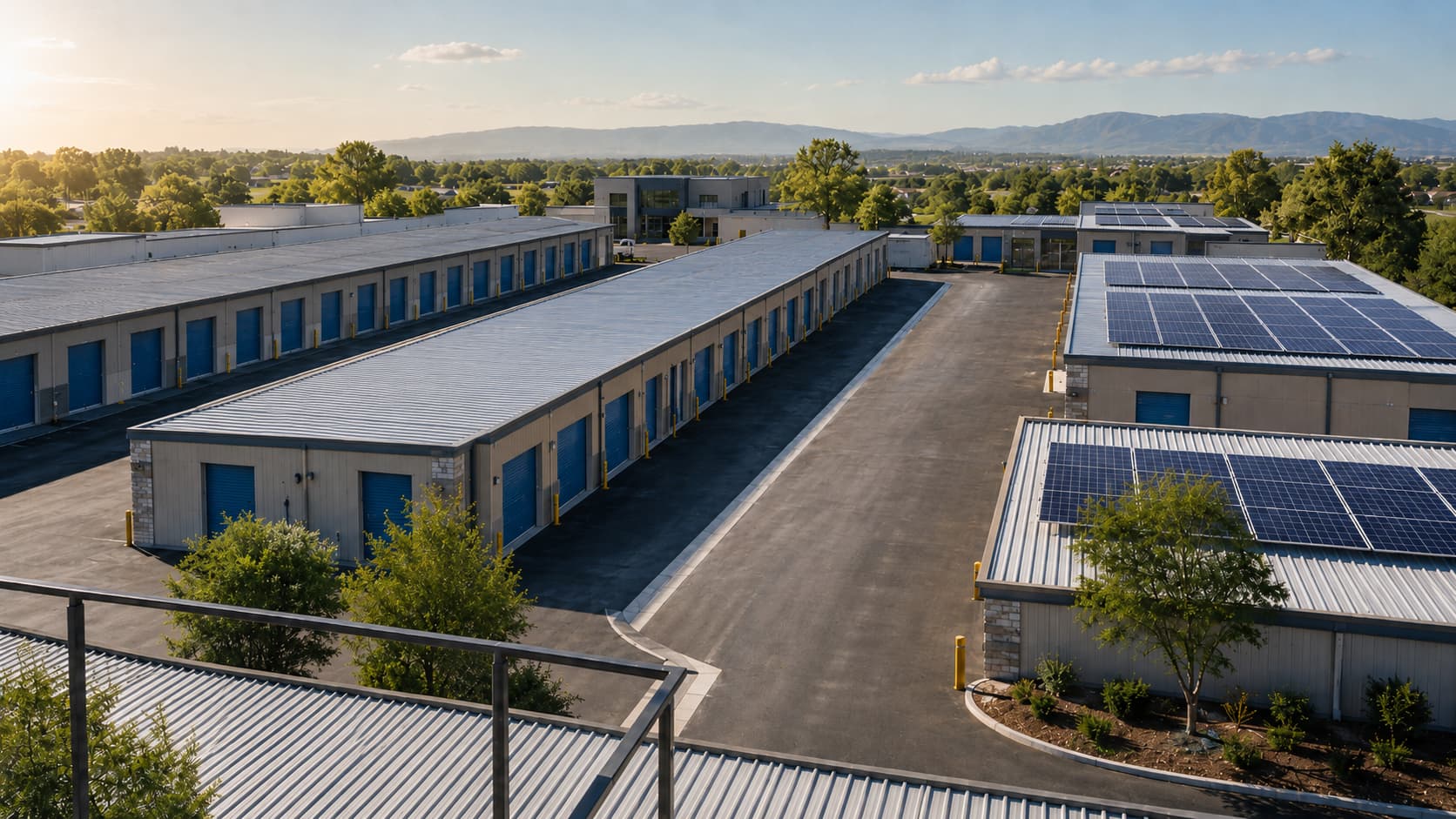
A self-storage facility can look like a strong opportunity from the road. The surrounding area is growing. New apartments are going up. Competing facilities appear busy. The property may even sit in a market with fewer square feet of storage per person than the industry average.
While those are encouraging signs, on their own they are not enough to establish demand.
Self-storage is highly local, and demand can change considerably within a few miles. A growing city can contain individual neighborhoods that already have more storage than they can support. A market that appears oversupplied on paper may still have room for the right unit types, location or facility design.
Before buying land, purchasing an existing facility or committing to an expansion, you need to understand who would rent from that particular property, what they need and how much additional storage the market can realistically absorb.
Begin with the facility’s realistic trade area
Many self-storage studies begin with a three-to-five-mile radius around the property. That can be a reasonable starting point, especially in suburban markets, but it should not automatically become the final trade area.
Customers do not choose facilities according to a perfect circle on a map. They make decisions based on convenience, familiarity, travel patterns and how easily they can reach the property.
A highway interchange may expand the distance customers are willing to travel. A river, railroad, mountain, toll road or divided highway may reduce it. A facility five miles away but directly along a customer’s commute may be more convenient than one two miles away that requires several difficult turns.
Population density matters, too. An urban facility surrounded by apartments may draw most of its customers from a small radius. A rural facility, vehicle-storage property or facility near a military installation may attract customers from considerably farther away.
Start with a radius, then test it against:
- Typical drive times
- Major roads and commuting patterns
- Physical and psychological neighborhood boundaries
- Traffic congestion
- Bridges, railways, rivers and other barriers
- Competing facilities located along the same travel routes
Download the entire checklist:
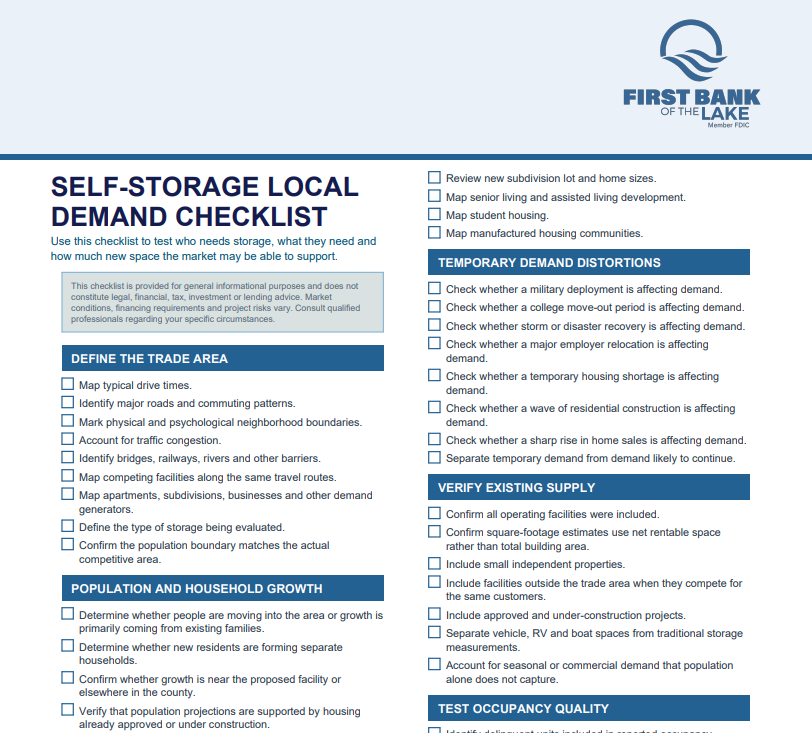
Click on the image to download
Remember, the goal is to identify the area from which customers are genuinely likely to come. If the trade area is drawn too broadly, the analysis may count thousands of people who would never consider the site. That can make demand appear stronger than it is.
Look at households, not population alone
Population growth is commonly used as evidence of future self-storage demand. Growth matters, but the number of people living in the market tells only part of the story.
Self-storage units are generally rented by households and businesses. A market adding 2,000 residents through larger household sizes may create less demand than one adding 2,000 residents through the formation of hundreds of new households.
Research both population growth and household growth. Then investigate how that growth is occurring.
Population forecasts should be treated as estimates. Compare them with evidence that can be seen locally, including building permits, subdivision approvals, apartment construction, utility extensions and school enrollment.
The American Community Survey provides annual estimates covering population, housing, income, renter concentration and residential mobility. Census migration data can also help show where residents are coming from and whether recent growth reflects sustained movement or a temporary spike.
Source: U.S. Census Bureau, American Community Survey Data1
Study the type of housing being added
Two markets with the same population growth may produce very different storage demand.
A new subdivision of large homes with garages and basements may create a different customer base than a development containing small apartments with limited closets and no garages. Condominium communities, senior housing, student housing and short-term rental activity can each affect demand differently.
Renters often have less storage space and may move more frequently, which can support demand. Still, renter concentration should be interpreted alongside household income and housing costs. A renter-heavy area may generate storage need while also limiting the monthly rate customers can comfortably pay.
Affordability can be just as important as need. Someone may benefit from additional space but decide the monthly cost is too high.
Separate ongoing demand from temporary demand
Certain events can produce a short-term increase in storage rentals:
These can support occupancy for a period without creating enough permanent demand to justify a long-term investment.
Look for durable demand drivers that can continue throughout the holding period. These may include steady household formation, a diverse employment base, sustained residential mobility, constrained living space and ongoing local business activity.
It is also helpful to understand why people in the market move. Residential moves have historically been an important driver of self-storage use, according to research discussed by the Self Storage Association. A community with regular household transitions may produce more recurring demand than a similarly sized community where residents rarely move.
Source: Self Storage Association, Industry Confidence Survey
Calculate storage square footage per capita carefully
Storage square footage per capita is one of the industry’s most familiar market measures:
BASIC CALCULATION
Existing rentable self-storage square footage ÷ trade-area population
For example, a trade area with 350,000 rentable square feet and 50,000 residents has seven square feet per capita.
The calculation is useful because it provides a quick picture of supply relative to population. Problems arise when it is treated as a final answer.
A market with relatively little storage per person may still have weak demand. A market with a higher ratio may support additional space because existing facilities are full, rates are stable and particular unit types remain difficult to find.
The Self Storage Association identifies population growth, housing development, market rents, incoming facilities, visibility, access and supply per capita as useful investment criteria. The association’s examples work well as screening tools, but individual thresholds should not be applied to every property or market.
Source: Self Storage Association, Identifying Investment Criteria for Self Storage Acquisition Opportunities
Square footage per capita tells you how much storage exists. It does not tell you whether people want it, whether it is the right type or whether the facilities are producing healthy revenue.
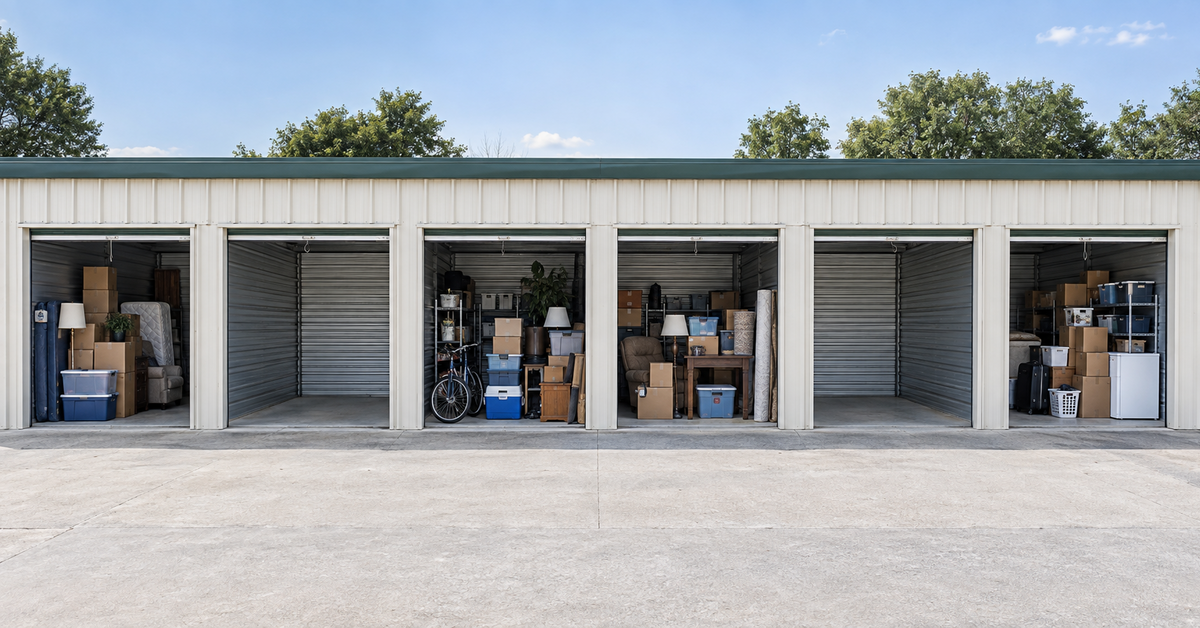
Determine whether competitors are truly full
Competitor occupancy is one of the most valuable pieces of market information and one of the hardest to verify.
Physical occupancy and economic occupancy are different.
Physical occupancy measures how much space is rented. Economic occupancy considers how much revenue the facility is collecting compared with its potential rental revenue. A property can be physically full while producing weaker-than-expected income.
A prospective buyer will rarely receive detailed financial data from competing properties. You can still gather meaningful evidence.
Call competitors at different times and ask about several unit sizes.
Repeat the calls over several weeks or months. If the same unit sizes remain available, the property may have more vacancy than a one-time survey suggests. If a competitor consistently lacks a certain size, that may reveal an unmet need.
Online rental systems can provide additional clues. Check whether units can be reserved immediately, whether discounts change and whether availability varies by floor or building. Keep in mind that online inventory may be intentionally limited or configured for marketing purposes.
No single observation proves occupancy. The goal is to build a pattern from multiple sources.
Calculate the effective cost to the customer
The advertised rate does not always reflect what the customer will actually pay.
For example, one facility may advertise a 10-by-10 unit for $95 per month, while another advertises the same size for $110. The lower-priced facility may also charge additional fees, require insurance or use promotional pricing that increases after the introductory period.
That can make the higher advertised rate more competitive over time.
When surveying competitors, estimate the customer’s total expected cost over the first three, six, and 12 months. This provides a more realistic comparison than looking at advertised rates alone.
Pay attention to discount intensity. Frequent “first month free” offers do not automatically indicate weakness because promotions are common customer-acquisition tools. However, increasing or prolonged concessions across several facilities may suggest that operators are competing aggressively for a limited number of move-ins.
Rate direction matters as much as the current rate. Flat or declining advertised rates can indicate pressure even when occupancy appears healthy. Yardi Matrix reported in 2026 that elevated supply continued to pressure annual rate growth in some markets, demonstrating why national or metropolitan trends still need to be checked against the immediate trade area.
Source: Yardi Matrix, National Self Storage Report, May 2026
Investigate the development pipeline in stages
Existing competition is only part of the supply picture. A market can appear balanced today while several facilities are moving toward construction.
Speak with local planning staff and review meeting minutes. Search using the property address, developer name and terms such as “mini-storage,” “self-storage,” “storage warehouse” and “conditional use.”
Do not count every proposed facility as if it will open. Classify the pipeline by probability:
- Prospective: A site has been discussed or identified, but meaningful approvals may not have begun.
- Planned: Applications or approvals are underway.
- Under construction: Work has started and delivery is considerably more likely.
- Recently opened: The facility is still leasing and has not reached stabilized occupancy.
Recently opened properties belong in the pipeline analysis because their full competitive effect may not appear immediately. A facility that opened six months ago may still have thousands of square feet to absorb.
Also consider timing. If your project requires two years for approvals and construction, today’s occupancy matters less than the supply-and-demand balance expected when your facility opens.
National pipeline numbers can provide context, but they cannot replace this local work. In early 2026, Yardi Matrix was tracking thousands of self-storage properties in various stages of development across the country. Only a portion of those projects will affect any particular trade area.
Source: Yardi Matrix, U.S. Self Storage Market Steps Cautiously Into 2026
Evaluate unit-level demand
A market is not simply full or vacant. Demand varies by unit size and facility type.
One area may have plenty of traditional drive-up storage but limited climate-controlled space. Another may have strong demand for small units while large units remain vacant. A market with heavy RV ownership may need covered vehicle storage while having no need for another multistory facility.
Climate-controlled demand should be evaluated against weather, local expectations, housing type, customer income and the items customers are likely to store. In some markets, climate control is expected. In others, customers may favor lower-cost drive-up access.
Vehicle storage requires its own analysis. Research local HOA restrictions, apartment parking limitations, RV and boat ownership, nearby lakes or recreational areas, competing storage configuration and municipal rules governing outdoor storage.
A waiting list for 10-by-20 units does not automatically support the construction of 50,000 square feet of general storage. It may support adding a limited number of larger units.
.jpg?width=2912&height=1632&name=Local%20Demand_4%20(1).jpg)
Include local businesses in the demand analysis
Population-based analysis can overlook commercial customers.
Contractors, restoration companies, online retailers, pharmaceutical representatives, property managers and other small businesses may use storage for inventory, equipment, records or supplies.
Talk with local businesses rather than assuming they need storage. Their requirements may differ from residential customers, and some uses may be prohibited by zoning, fire codes or the rental agreement.
Know when to order an independent feasibility study
The study should do more than collect demographics. It should define the trade area, verify competitive inventory, examine the development pipeline, evaluate unit mix, estimate achievable rents and model absorption.
The Self Storage Association describes a feasibility study as an industry expert’s opinion about the financial viability of a facility of a particular size in a particular location, based on local research, industry standards and trends.
Use a consultant who is independent of the seller, broker and contractor. Ask how competitor occupancy was verified, how pipeline projects were treated and what evidence supports the projected rents and lease-up schedule.
Local demand should lead the decision
A self-storage opportunity should not begin with how much land is available or how large a building can fit on it. It should begin with the amount and type of storage the local market can support.
Demographic reports are useful. Industry benchmarks are useful. Competitor websites are useful. However, each offers only one view. The clearest demand picture comes from combining data with direct market evidence: driving the trade area, talking with planning officials, monitoring competing facilities, tracking rates and promotions, researching the development pipeline and understanding the people and businesses likely to rent.
Have a Self-Storage Deal That Needs a Closer Look?
Self-storage financing rarely fits neatly into a standard lending box. First Bank of the Lake specializes in self-storage lending, including complex or unusual transactions that require experienced underwriting and a thoughtful approach.
Whether you are considering an acquisition, new construction, expansion or refinance, our lending specialists are ready to learn about your project and help you explore a financing structure that fits the opportunity.
Connect with a Self-Storage Lending Specialist
Frequently Asked Questions About Self-Storage Market Demand
1. How do you determine whether a market needs another self-storage facility?
Start by defining the facility’s realistic trade area and measuring population growth, housing development, renter concentration, mobility and local business activity. Then compare those demand drivers with existing and planned storage supply. Competitor occupancy, waiting lists, promotions and rate trends often reveal more than population data alone.
2. What is the typical trade area for a self-storage facility?
Many self-storage facilities draw most customers from within three to five miles, but that range is only a starting point. Dense urban markets may have smaller trade areas, while rural facilities may serve customers from farther away. Roads, traffic patterns, physical barriers, visibility and competing facilities can materially change the area.
3. How much self-storage square footage per capita is considered healthy?
There is no universal square-footage-per-capita threshold that determines whether a market is healthy. The appropriate level depends on population growth, household characteristics, renter activity, housing development, local demand drivers and the quality of existing supply. Use square footage per capita as a screening measure, then verify it with market-specific evidence.
4. How can you tell whether competing self-storage facilities are actually full?
Call competitors as a potential customer and ask about several unit sizes, pricing, promotions and availability. Track whether certain sizes have waiting lists and repeat the calls over time. Website availability can help, but it may be incomplete. Physical visits, management conversations and consistent rate behavior provide additional evidence.
5. What demand drivers are most important when evaluating a self-storage market?
Important drivers include population and household growth, apartment and subdivision development, renter concentration, household mobility, income, home size and local business activity. Colleges, military bases, seasonal residents, major employers and recreational activity may create additional demand. The strongest analysis connects these factors to actual customer behavior in the trade area.
6. How should planned self-storage developments affect a market study?
Include proposed, approved and under-construction facilities in the supply analysis. Confirm their size, unit mix, climate-control offering, construction status and expected opening date with local planning and permitting officials. A project that has only been discussed should be weighted differently from one that is financed, permitted and actively being built.
7. When should a buyer or developer order an independent self-storage feasibility study?
An independent feasibility study is especially valuable for new construction, expansions, unfamiliar markets and projects that depend on aggressive rents or lease-up assumptions. It should define the trade area, verify existing and planned supply, assess achievable rates, recommend unit mix and estimate how quickly the market can absorb the proposed space.
Why Work with First Bank of the Lake
The friendly financial experts at First Bank of the Lake offer SBA loans designed with the needs of our customers in mind. We have financed more than $2 billion in SBA loans since 2020 and were ranked the 15th-largest SBA lender in the United States since 2023. Since our founding in October 1985, we have offered outstanding customer service and the best financial options for customers’ needs. Today, First Bank of the Lake offers loans for business enterprises across the United States. To learn more about our bank or learn more about SBA loans, visit our website or check us out on Facebook or LinkedIn. Our friendly and knowledgeable staff members will be happy to discuss your loan options with you and to help you achieve success in the chosen industry. Please contact us at (888) 828-5689 or fill out the form below to get your business loan questions answered today!
1 https://www.census.gov/programs-surveys/acs/data.html