


Find what’s limiting your manufacturing output, from downtime and staffing gaps to production flow, before investing in more equipment or space.
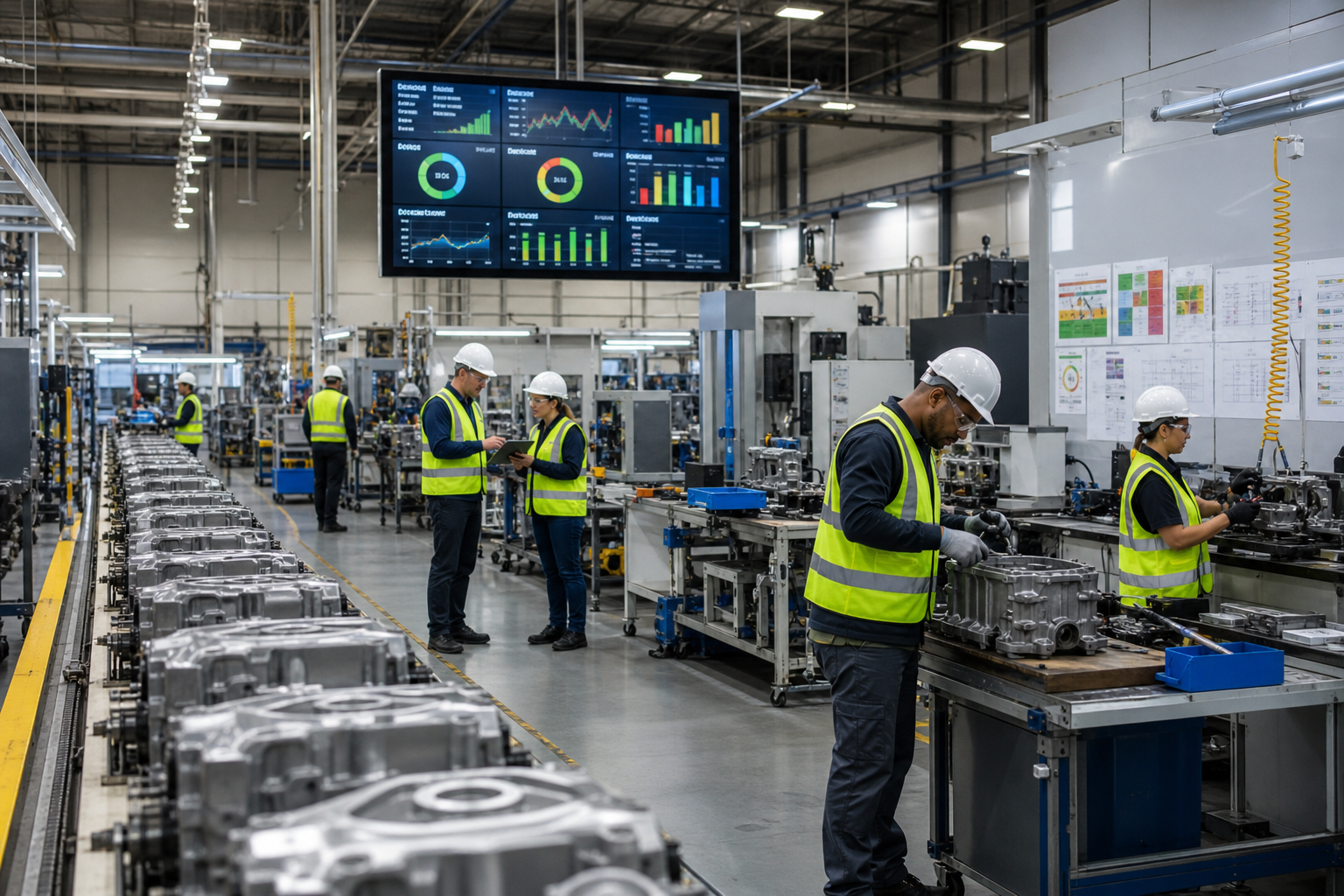
You may already have a machine in mind. The queue ahead of an operation keeps growing, overtime has become part of the schedule, or work is going outside because you cannot get it through the shop when customers need it.
Another machine could be the right investment. The question is what it would change for the operation as a whole. Would more parts reach the customer, would delivery become more dependable, or would the waiting simply move to another step?
You know where the pressure shows up. Connecting that experience with a few production measures can help distinguish a need for more equipment from a need for automation, a different layout, additional skills or a change in how work moves through the business. That distinction also gives a lender a clearer understanding of the project you want to finance.
Start with the work you need to get through
A shop can be busy across several departments and still struggle to complete the orders that matter most. For an investment decision, a useful starting point is the finished, accepted output you need for a particular product family or route, compared with what that route currently delivers.
The product mix matters. A week of repeat orders can place very different demands on equipment and people than a week of short runs, difficult materials and frequent setups. Comparing those weeks only by total units can hide the reason the schedule tightened.
For the work affected by the proposed investment, bring together:
- Accepted output and delivery performance over a representative period, alongside the order mix.
- Where jobs wait, how long they wait and what has to happen before they can move.
- The machine time, staffed hours and outside processing the work actually uses.
The period should capture the conditions behind the decision. A seasonal peak, a recurring customer program and a temporary recovery from a breakdown deserve different explanations. There is no single utilization percentage that settles all three.
NIST’s Manufacturing Extension Partnership describes value stream mapping as a way to examine both production and information flows. Its approach begins with a selected product stream and the current condition before moving to potential improvements. That can provide a structured view when several departments see different parts of the delay. [1]
What the production signals may be telling you
The same symptom can support different decisions. Overtime may reflect sustained demand at a constrained operation, or it may be recovering time lost to missing material and rework. A queue can identify an operation worth examining without proving that another machine is the answer.
| What you observe | What deserves a closer look | Possible decision |
|---|---|---|
| A recurring queue at one operation | Actual processing time, setups, staffing and downstream capacity | Add equipment or improve availability |
| Equipment available but waiting for people | The specific skill or task holding up operation | Cross-train, redesign work or automate a defined task |
| Parts waiting for inspection or release | Measurement capacity, first-piece approval and documentation | Expand quality capacity or improve the handoff |
| Growing outside-processing costs | Supplier lead time, internal volume and the full cost to bring work inside | Keep outsourcing, add a supplier or bring a process in-house |
| Congestion and repeated handling | Layout, staging, storage and usable production space | Reconfigure the floor or expand the facility |
| Unclear or inconsistent evidence | Temporary disruptions, changing mix and gaps in the available records | Test a smaller change before committing |
Use these as starting points for discussion. Several conditions may exist together, and the strongest investment may address more than one.
Queues and work in process need context
A recurring queue before the same operation can support the case for additional capacity, especially when that operation is consistently supplied, staffed and running. A queue that forms only after large batches are released may tell a different story about scheduling or transfer sizes.
The age and readiness of the work are useful distinctions. Jobs waiting for a machine, jobs waiting for a revised drawing and jobs being held for customer approval may occupy the same floor area. Only some of that work is ready for more equipment to process.
Consider a hypothetical shop where machining finishes parts faster than inspection can release them. A second machining center could increase the inspection queue while shipments remain unchanged. If inspection capacity is expanded too, both investments might support higher output. The combined plan would have a different budget and staffing requirement from the machine purchase alone.
This is why it helps to examine the next operation as part of the equipment decision. The constraint may move after an improvement. The first investment can still be the right one. What changes is how much benefit the business can expect from it by itself.
Overtime and downtime can point to different purchases
Overtime is more informative when it is tied to the work being recovered or added. Extra hours on the same productive operation, supported by recurring orders, may strengthen the case for another machine. Extra hours spent repeating setups, replacing rejected parts or waiting for repairs raise different questions.
Downtime needs the same distinction. A breakdown, a planned changeover and a wait for material all reduce available production time, but a new machine will not address them in the same way. NIST distinguishes reactive, preventive and predictive maintenance approaches, underscoring that equipment reliability itself is an area for investment and analysis. [2]
Where reliability is the issue, the comparison may include repairing or rebuilding existing equipment, replacing it, or adding backup capacity. A replacement may be worthwhile because it makes delivery more dependable even when the expected increase in weekly volume is modest. That is a different investment case from selling a larger number of parts.
Scrap, rework and inspection affect usable capacity
Production hours spent on rejected or repeated work are part of the capacity picture. The investment question is whether the loss comes from the equipment’s capability or condition, or from something else in the process, such as incoming material, tooling, workholding or an unstable setup.
A replacement machine may help if the current equipment cannot consistently hold the required tolerance. If the defect begins elsewhere, additional machine speed may leave the underlying quality problem in place. The useful comparison is the expected cost and output of accepted parts, including the work required to achieve them.
Inspection delays also deserve a specific explanation. A shortage of measurement capacity may support another instrument or an automated inspection system. A delay in first-piece approval, missing documentation or a customer release may require a different response. Any change to inspection needs to preserve applicable quality and customer requirements.
Separating these causes gives the project a more credible benefit statement. It also avoids counting the same improvement twice, for example, claiming both fully recovered rework hours and full use of those same hours for additional production without explaining the assumptions.
Staffing gaps may make automation relevant
When a machine is available but a qualified person is not, buying another similar machine may leave the same staffing question unresolved. The answer could involve training, fixtures that simplify a task, automated loading or a different assignment of work across the cell.
The automation case becomes more specific when it names the task and the people it would support. Reducing repetitive loading could allow an experienced operator to oversee more work. Automating a different step might reduce handling or improve consistency. Neither result should be assumed from the equipment specification alone.
NIST’s guidance on robot integration emphasizes involving the people who know the existing process, accounting for inconsistencies and allowing time for training and implementation. [3] For your project, that means considering who will program, change over, maintain and troubleshoot the system after it is installed.
Some staffing needs remain even when a task is automated. The financial case should reflect the labor expense likely to change, any additional support required and when those changes are expected. Hours freed for other work do not automatically become payroll savings.
Outsourced work can support a different investment case
Outside processing may be an intentional part of your operation. It can provide a specialized capability, flexibility during peaks or access to capacity you do not need every week. A rising outside-processing bill alone does not establish that bringing the work inside will be the better choice.
The case becomes clearer when the recurring volume, supplier turnaround and cost of coordination are considered alongside the internal alternative. Bringing a process in-house may give you more control over delivery or create a capability customers want. It also brings responsibility for staffing, quality, maintenance and any applicable facility or environmental requirements.
A useful comparison includes:
- Outside processing, freight, handling and the time work remains away from the shop.
- Internal equipment, tooling, labor, consumables, utilities and maintenance.
- Qualification, training and the period when outside processing may continue during startup.
If the supplier relationship will remain important for overflow or backup, include that in the plan. The realistic comparison may be a combination of internal and external capacity rather than a complete switch.
Space may be limiting movement or limiting the business
A crowded floor can make an expansion feel necessary. The details help distinguish space occupied by waiting work from space needed for the next stage of production. Staging, material travel, access for maintenance and shipping flow can all affect how much of the building is useful for the work.
A layout change may address repeated handling within the existing footprint. A larger facility may be justified when the planned equipment, utilities, storage and safe access cannot reasonably fit. Any layout comparison needs to preserve safety, access and applicable code requirements.
For a complex move or production change, simulation can help compare alternatives. NIST identifies layout, product mix, operator assignments, reliability and throughput among the factors manufacturers can examine through simulation. [4] The value depends on how well the model represents the operation and its assumptions.
If expansion remains the right answer, the project includes the transition as well as the finished space. Moving equipment, paying for overlapping locations and restarting production can affect cash needs before the new layout delivers its expected benefit.
Holding off can be a specific decision too
You may have enough information to commit now. You may also have two plausible explanations for the same production pressure and want to test one before taking on the larger expense.
A limited trial can be tied to the unresolved question: different staffing coverage, a revised release schedule, maintenance work or a change to staging. The useful result is whether accepted output, delivery performance or overtime changes under comparable conditions. It does not require assuming the smaller change will solve the problem.
Holding off has a cost as well. Continued outsourcing, repairs, overtime or business you cannot accept belong in the comparison. A reason to pause is strongest when it names the evidence still needed and the point at which the investment will be reconsidered.
Connect the production decision to the financing conversation
Once the likely constraint is clearer, the project can be explained in terms a lender can evaluate: what you want to change, what it will cost, when it can begin contributing and how the business expects to carry the payments.
The benefit may be additional sales, lower outside-processing expense, less rework or more dependable delivery. Each calls for different support. Additional capacity needs a credible demand assumption. Cost savings need an explanation of which expenses will actually fall. Reliability benefits may require a case built around avoided disruption rather than a large sales increase.
Bring the operational evidence you already have, together with:
- The proposed investment and the alternatives you considered.
- The full project cost, including installation, integration, training and any facility work.
- A realistic startup schedule and the cash needed before expected benefits begin.
- The assumptions that would change the result, such as a later production start, a different order mix or continued staffing gaps.
The cash forecast should also account for the work the added capacity would support. More accepted orders may require additional material and payroll before customer payments arrive. A project that reduces outsourced work may have a different cash pattern, including a period of overlapping costs.
You do not need every uncertainty resolved to begin that conversation. You do need room to explain the business behind the request, including why another machine, automation, a new process or a larger facility is the option you are considering.
First Bank of the Lake offers financing for manufacturing equipment, facilities and expansion projects. [5] Talk to one of our manufacturing lending specialists about the investment you have in mind, the production issue it addresses and the parts you are still working through. Call (888) 828-5689 or visit our manufacturing loans page.
Frequently asked questions
1. How can I tell whether another machine would increase production?
Connect the machine’s expected contribution to the complete route. Consider whether work is ready for it, whether qualified people can operate it and whether downstream steps can accept the additional output. Another machine can also have value for reliability or a new capability, even when immediate volume growth is limited.
2. Does a long queue prove an operation needs more capacity?
It identifies a place to investigate. The queue may reflect processing capacity, batch releases, setups, staffing or work that is not ready to proceed. Its pattern over time and the reason jobs are waiting are more informative than a single snapshot.
3. Should overtime be included in an equipment investment analysis?
Yes, with an explanation of what causes it and which hours the project is expected to reduce. Some overtime may support additional sales; other hours may recover lost time. Compare the anticipated expense changes with the equipment payment and the costs of operating the new asset.
4. Can automation help when hiring is difficult?
It may help with a defined task that is suitable for automation. The plan still needs to address programming, training, changeovers and maintenance. It should also distinguish people reassigned to other work from labor costs that would actually be eliminated.
5. When does bringing outsourced work in-house make sense?
It may be worth evaluating when recurring volume, delivery control, quality needs or a new capability support the investment. Compare the complete internal cost and startup requirements with the outside option, including any outsourcing you expect to retain for backup or peaks.
6. Should we change the layout before expanding the facility?
A layout review can help establish what the existing space can reasonably support. It does not mean expansion is unnecessary. Equipment size, utilities, access, storage and the planned production mix may still justify a larger footprint.
7. What if the limiting step changes after we invest?
That can happen as one part of the process gains capacity. Include the likely next constraint in the forecast so the expected benefit does not assume unlimited capacity elsewhere. The plan may call for a phased investment or more than one improvement.
8. Can we speak with a lender before choosing the final equipment?
You can begin with the production issue, the options being evaluated and preliminary costs. A conversation can help clarify the information needed to review the financing. It does not establish eligibility or approval before the lender completes its review.
Sources
[1] NIST Manufacturing Extension Partnership, Value Stream Mapping
https://www.nist.gov/mep/value-stream-mapping
[2] NIST, Manufacturing Machinery Maintenance
https://www.nist.gov/el/applied-economics-office/manufacturing/topics-manufacturing/manufacturing-machinery-maintenance
[3] NIST Manufacturing Innovation Blog, How to Make Your First Robot Integration a Success
https://www.nist.gov/blogs/manufacturing-innovation-blog/how-make-your-first-robot-integration-success
[4] NIST Manufacturing Innovation Blog, Simulation is a Window Into the Future of Your Manufacturing Operation
https://www.nist.gov/blogs/manufacturing-innovation-blog/simulation-window-future-your-manufacturing-operation
[5] First Bank of the Lake, Manufacturing loans
https://offers.fblake.bank/manufacturing-loans
Sources reviewed October 23, 2026. The production examples and decision comparisons are illustrative applications, not reported customer results or an operational assessment of a specific business.
Talk to a manufacturing lending specialist
Why Work with First Bank of the Lake
First Bank of the Lake helps business owners nationwide find the financing they need to grow, expand, and invest in what comes next. Our experience has made us one of the country’s leading SBA lenders. Since 2023, First Bank of the Lake has ranked among the top 1% of SBA 7(a) lenders, placing 15th nationwide by approval amount, and has also ranked as the third most active SBA franchise lender by lending volume, according to the U.S. Small Business Administration.
Founded in 1985, we combine national lending capabilities with the personal attention you would expect from a community bank. Our knowledgeable team takes the time to understand your goals, walk you through your options, and support you at every step.
If you are considering financing for your business, we would be happy to answer your questions. Call us at (888) 828-5689 or complete the form above to start the conversation. You can also visit our website or connect with us on Facebook and LinkedIn.


